
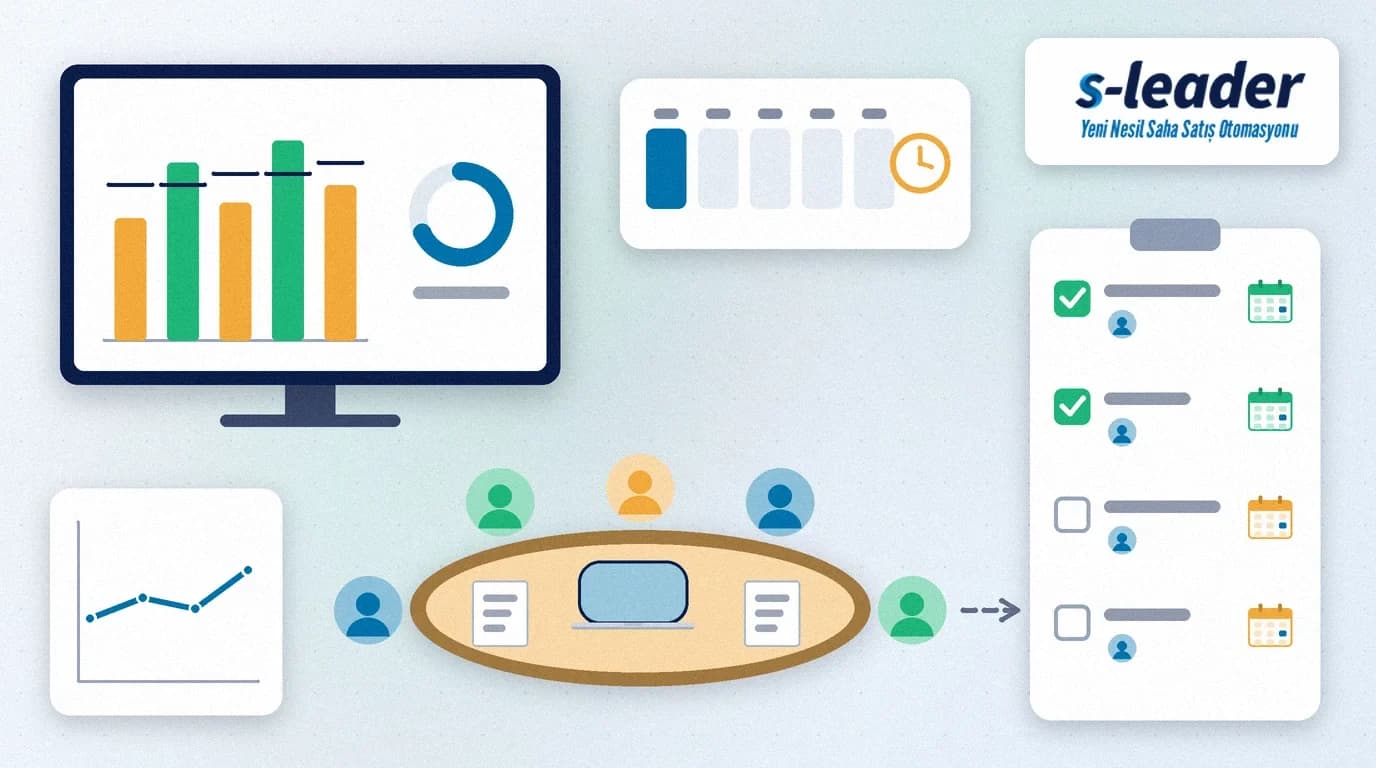
In short: A weekly sales meeting is a short meeting with a fixed agenda, held on the same day and at the same time every week, in which the sales manager and the team review last week against figures shared in advance and set next week's priorities. A good meeting does not end with reading reports but with actions that have an owner and a date.
In many sales teams the weekly meeting turns into a long round where everyone describes their week in turn, or into a presentation where every table on the screen is read out. The meeting ends, yet nobody knows who will do what by when. This guide explains step by step how a sales manager prepares the meeting from data, runs it with a fixed agenda and follows up on decisions.
What is a weekly sales meeting and what is it for?
A weekly sales meeting is a regular meeting to review the sales team's performance at team level, spot deviations early and agree on next week's priorities together. Its purpose is to make decisions, not to pass on information.
It should not be confused with two other conversations. Individual performance, targets and development belong in one-to-one meetings between the sales manager and each team member. Monthly or quarterly reviews deal with strategy, pricing and target changes. The weekly meeting sits between the two and stays short-term and practical.
Which data should be ready before the meeting?
Figures should not be worked out in the meeting room; everyone should have them before the meeting starts. A short data set, prepared every week in the same format by the sales manager or the sales support team, is enough:
- Target versus actual: weekly and month-to-date sales by team and region.
- Orders: number of orders, average order value and large orders.
- Visit plan compliance: planned versus completed visits.
- Customer movements: newly opened accounts and customers who have not ordered for a while.
- Collections: overdue receivables and those falling due this week.
- Returns and complaints: the notable cases of the week.
- Last week's action list: with the status of each item.
For choosing the indicators, see our article on field sales team KPIs; for spotting customers who have stopped ordering, see inactive customers. Sharing the data set one day before the meeting lets participants come with their questions ready.
The weekly sales meeting agenda in 6 steps
The agenda should follow the same order every week. That way the team knows what to prepare and the meeting does not overrun.
1. Start with last week's actions
For every decision taken at the previous meeting, ask one question: was it done? If not, why not, and what is the new date? Skip this step and the action list soon becomes a file nobody opens.
2. Review target versus actual and focus on deviations
Instead of reading the whole table, discuss only the regions, product groups or customer groups that clearly deviate from target. We cover day-to-day tracking of targets in sales quota progress.
3. Deal with exceptions
Talk about the unusual: a large order that was lost, an important customer who has stopped ordering, an unexpected wave of returns. There is no need to go through everything that is on track.
4. Review collections and risks
Overdue receivables and customers close to their credit limit belong in the same discussion as sales. Goods that are sold but not paid for meet the target on paper while straining cash flow.
5. Clarify obstacles and the support needed from head office
List the issues the team cannot solve on its own, such as stock shortages, orders waiting for approval, or pricing and promotion questions, and name an owner at head office for each.
6. Close with written actions
The meeting ends with the action list being read out. Every action needs an owner and a date. The list is shared with the team the same day and becomes the first item of the next meeting. For ways to pass decisions on to the field team, see field team communication.
Productive versus unproductive sales meetings
Preparation: in an unproductive meeting the figures are put together during the meeting; in a productive one they are shared a day earlier. Figures: an unproductive meeting reads the whole table; a productive one discusses only deviations. Structure: in an unproductive meeting everyone describes their week in turn; a productive one follows a fixed agenda. Length: an unproductive meeting runs to a different length every week; a productive one has a fixed slot. Output: an unproductive meeting ends with general advice; a productive one ends with actions that have an owner and a date. Follow-up: in an unproductive meeting decisions are forgotten; in a productive one the next meeting starts with the actions.
How do field and office teams meet in the same meeting?
Because field reps spend the day with customers, it is practical to hold the meeting outside visiting hours, for example on the first day of the week before visits begin or on the last afternoon of the week. Team members in remote regions can join online; what matters is that everyone looks at the same data set.
Office teams such as sales support, dispatch or accounting can join only for the part that concerns them. That way obstacles find an owner in the meeting and nobody loses an hour for nothing.
Common mistakes
Turning the meeting into report reading: reading out figures everyone could have seen beforehand wastes time. Discussing individual performance in front of the team: this belongs in one-to-ones and makes people defensive in a team setting. Starting without an agenda: without a fixed agenda the meeting drifts to whoever talks the most. Not writing down actions: verbal decisions are remembered differently a week later. Changing the time every week: an irregular meeting leads to irregular preparation.
How does S-Leader support meeting preparation?
S-Leader has no separate meeting module, but its existing features support preparing the data for the meeting and passing decisions on to the field. Transactions made in the field can be followed in the web-based BackOffice, and the report designer lets you build custom reports and share them in graphical and numerical form. Route compliance is reported with location and time, and overdue and upcoming collections are visible. Decisions taken in the meeting can be passed on to the field team with push notifications and in-team messaging. When used with Logo or Mikro ERP, approved orders and collections are recorded in the ERP.
Summary
A productive weekly sales meeting takes place on the same day and at the same time each week, shares the data a day in advance, starts with last week's actions, discusses only deviations and exceptions, gives every obstacle an owner at head office and ends with an action list that has owners and dates. To see how S-Leader can help you prepare reports for the meeting, get in touch with us.
Sıkça Sorulan Sorular
How long should a weekly sales meeting last?
It depends on team size and agenda; what matters is that it stays short and the same every week. If the data is shared beforehand and only deviations are discussed, most teams can keep the meeting under an hour.
Which day is best for a weekly sales meeting?
Choose a time that does not get in the way of customer visits. The first day of the week before visits begin, or the last afternoon of the week, are common choices. Keeping the day and time fixed matters most.
Should individual performance be discussed in this meeting?
No. The team meeting covers deviations at team and regional level. An individual's targets, performance or development should be handled in one-to-one meetings with the sales manager.
Does the field team need to come to the office for the meeting?
No. Team members in remote regions can join online. What matters is that everyone has looked at the same data set beforehand and that the action list is shared with everyone on the same day.