
Field Sales Route Planning: How to Optimize Your Visit Routes
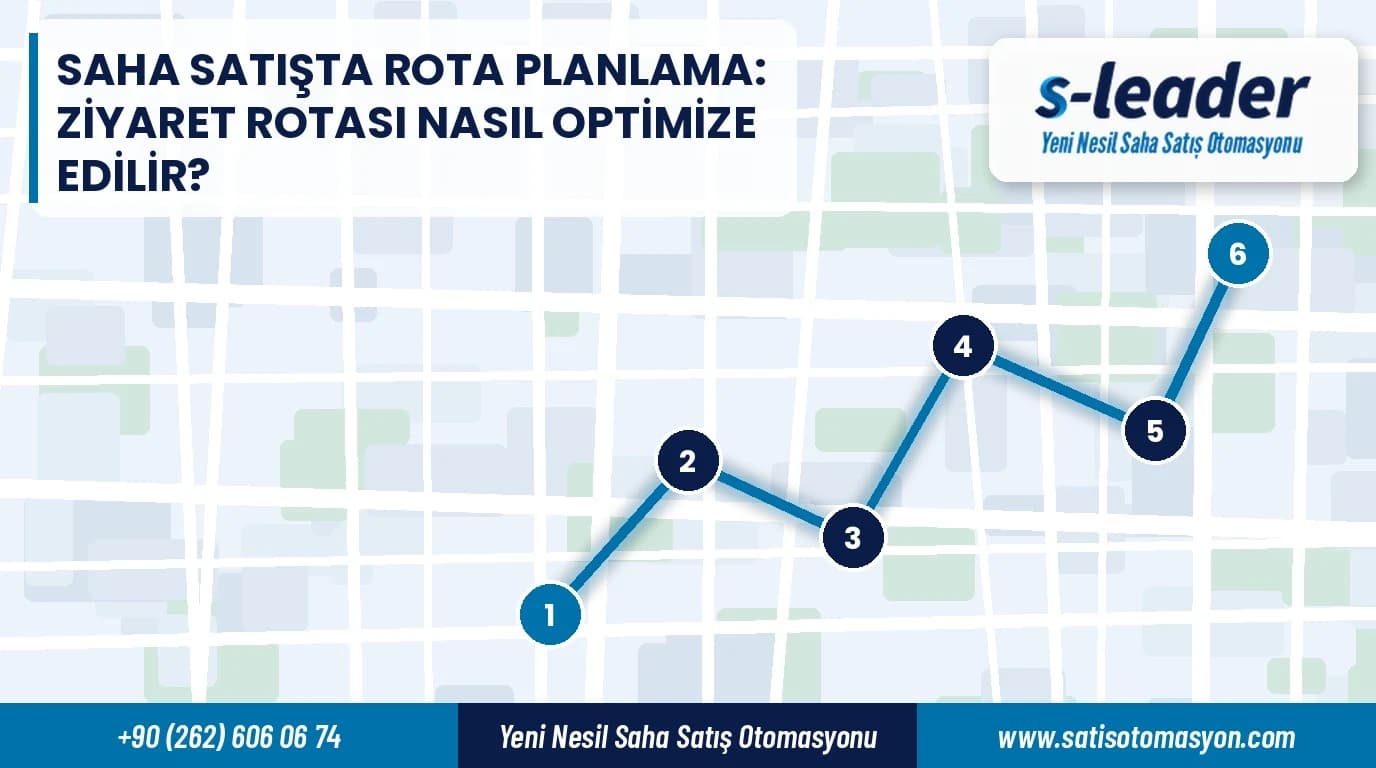
How many customers a field sales rep can visit in a day depends largely on the order in which those visits are made. In a team where routes are left to habit or to whatever order comes to mind that morning, a large share of the day is spent driving; some customers are visited more often than necessary while others are skipped for weeks. In this article we look at what field sales route planning is, which criteria to use when optimizing visit routes, and how to check whether the plan is actually followed in the field.
Quick summary
- Field sales route planning means deciding in advance which customer is visited on which day, in what order and how often.
- A good route plan considers not only distance but also customer importance, visit frequency, open receivables and customers' delivery acceptance hours.
- Dynamic route optimization automatically calculates the order in which the day's visits can be completed in the shortest time, saving time and adding consistency compared with manual sequencing.
- Whether the planned route is actually followed should be measured as route compliance, by recording each visit's location and times.
What Is Field Sales Route Planning?
Field sales route planning is the process of dividing a sales rep's customer portfolio into days and visit sequences. The plan has two layers: first, the visit plan, which defines which customer is visited on which day and how often (weekly, every two weeks, monthly); second, the daily route, which defines the order of that day's visits. For companies working through distributor, wholesaler or dealer networks, the route plan is the backbone of field sales operations, because orders, collections and stock checks all happen during these visits.
The Hidden Costs of Unplanned Routes
A route that is unplanned or based purely on habit may not seem like a problem at first. Over time, however, the following symptoms appear:
- More time on the road: Customers close to each other end up on different days, and the rep drives to the same area several times a week.
- Unbalanced visit frequency: Customers that are easy to reach or friendly get frequent visits, while distant or difficult customers are skipped and lost orders there accumulate unnoticed.
- Delayed collections: If a customer with a payment due isn't on the route that week, the collection slips to the next visit.
- Unmeasurable performance: Without a plan, the question "was the plan followed?" can't even be asked, and managers end up discussing guesses with the field team instead of concrete data.
How to Build an Effective Route Plan
1. Segment your customers
Not every customer needs to be visited equally often. Grouping customers by revenue share, order regularity and growth potential (for example into A, B and C segments) is the most practical way to set visit frequency. High-revenue customers who order regularly can be visited more often, and low-volume customers less often.
2. Set visit frequency and days
The visit frequency defined per segment is combined with geographic proximity and distributed across the days of the week. Grouping customers in the same area on the same day forms the basis of the daily route. At this stage, customers' delivery acceptance hours, closing days and any fixed delivery days should also be taken into account.
3. Optimize the daily visit sequence
Once the day's visit list is set, the visits are put in order. With only a few customers this can be done by hand, but as the number of visits grows the possible combinations multiply quickly and finding the most efficient order manually stops being practical. This is where dynamic route optimization comes in: the system automatically calculates the order in which the day's visits can be completed in the shortest time.
4. Reflect collections and priorities in the route
Routing is not just a distance problem. Customers with overdue payments, customers entering a campaign period or customers whose stock has dropped to a critical level should be prioritized on that day's route. That's why planning routes in the same system that holds account balances and collection data lets the plan follow real needs.
Route Compliance: How Do You Know the Plan Is Followed?
Even the best plan creates no value if it isn't followed in the field. Route compliance is the metric that shows how many of the planned visits were carried out on the planned day and in the planned order. Measuring it requires recording each visit's location and start/end times. With this data, managers can see which visits were skipped, where reps stayed longer than expected, and where the plan is unrealistic. To evaluate route compliance together with other metrics such as coverage, collections and orders per visit, see our article on field sales team KPIs.
Route compliance should be used as an improvement tool rather than a policing tool. A route with consistently low compliance often points to a problem with the plan rather than the rep: too many daily visits may have been scheduled, traffic and distance may not have been considered, or customers' acceptance hours may have been overlooked.
Spreadsheet Route Planning or Route Optimization Software?
In a small team, route planning can start with a spreadsheet and a map app. But as the number of customers and reps grows, spreadsheets go out of date, the plan has to be reworked by hand whenever a new customer is added, and the gap between planned and actual visits can't be measured. Field sales software that handles route planning in the same system as orders, collections and account data brings planning, execution and reporting together in one place. For criteria beyond route planning when evaluating a field sales system, our article on the 10 criteria for choosing field sales automation can also help.
Route Planning and Dynamic Optimization with S-Leader
With S-Leader, daily visit routes are created and the visit order that can be completed in the shortest time is calculated automatically. Because the location and time of each visit are recorded, route compliance can be reported; managers can follow the field team on a map and track the gap between planned and actual visits in the web-based BackOffice panel. During a visit, the rep can see the customer's account balance, overdue collections and order history in the field, so every stop on the route is well prepared; approved orders and collections are posted automatically to Logo or Mikro ERP.
If you'd like to see how your field team's routes could be planned more efficiently based on your own customer structure, you can request a free demo.
Sıkça Sorulan Sorular
What is the purpose of field sales route planning?
By deciding in advance which customer is visited on which day, in what order and how often, it reduces time spent on the road, prevents customers from being skipped and makes it possible to compare planned and actual visits.
What is the difference between route planning and route optimization?
Route planning is the overall decision about which customers are visited on which days and how often. Route optimization is putting a given day's visit list into the order that can be completed in the shortest time. The two complement each other.
How is customer visit frequency determined?
Customers are usually segmented by revenue share, order regularity and growth potential. High-volume customers who order regularly are visited more often and low-volume customers less often; frequency should be reviewed periodically based on results.
How is route compliance measured?
The location and start/end time of each visit are recorded and compared with the planned visits. The share of planned visits completed on the planned day and in the planned order shows route compliance.
Is a spreadsheet enough for route planning?
It can be enough at the start for a few customers and reps. As the portfolio grows, keeping the plan up to date, finding the most efficient order by hand and measuring route compliance get harder; at that point field sales software that handles routes together with orders and collections is more sustainable.
What does S-Leader offer for route planning?
In S-Leader, daily visit routes are created, the visit order that can be completed in the shortest time is calculated automatically, and route compliance is reported using location and time data. Managers can follow the field team on a map.