
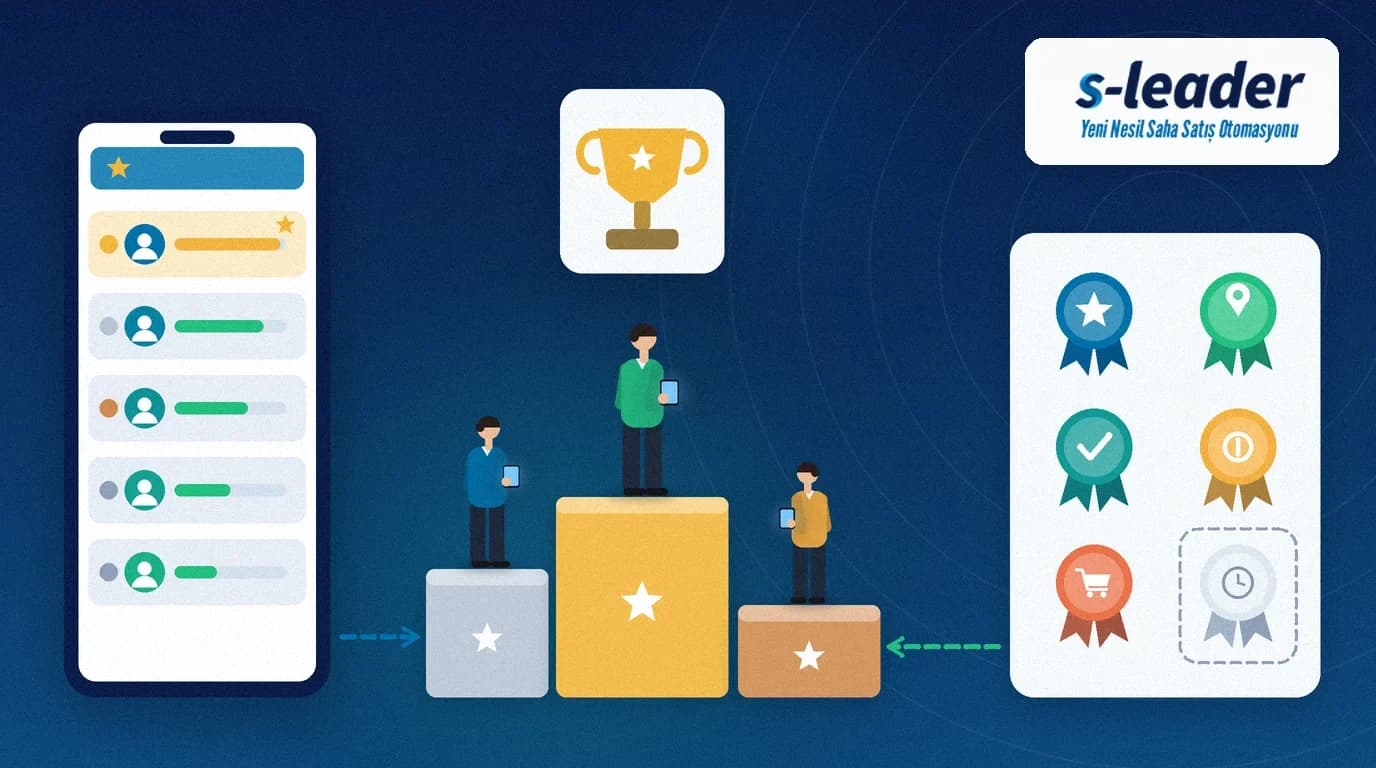
In short: Sales gamification in field sales means making a rep's daily work visible and recognised with game elements such as badges, leaderboards and period rankings. Done well, sales gamification rewards not only revenue but also sticking to the visit plan, collecting payments and keeping accurate records, and because the rules are fair it builds a sense of progress rather than rivalry.
At month end the sales manager gathers the team and congratulates the rep with the highest revenue. The same name comes up every month; that rep covers the region with the biggest customers. The rep on the small grocery route completes every planned visit and collects on time, but never appears on any list. A few months later that rep's drive fades. Set up properly, gamification makes this invisible effort visible too.
What is gamification?
Gamification is the use of game design elements such as points, badges, levels and rankings in a work setting that is not a game.
This is also the definition widely used in research: the 2011 paper by Deterding and colleagues defines gamification as the use of game design elements in non-game contexts. In field sales, game elements are not a layer of fun but a feedback tool that shows the team every day which behaviour matters.
When does sales gamification work in field sales?
Gamification works when the measured behaviour is within the rep's control and the result shows up quickly. Whether a visit happened, a payment was collected or the end-of-day report was closed is clear the same day. Behaviours like these suit badges and rankings.
The cases where it backfires are just as clear: ranking by absolute revenue without accounting for regional differences, rewarding only first place, or changing rules mid-period. Then the leaderboard becomes a screen that reminds most of the team every day that they are losing.
Which field behaviours should you reward?
Visit plan adherence: actually visiting the planned customers is the foundation of field sales. A badge for high route adherence makes steady work visible.
Target attainment rate: looking at attainment against each rep's own target instead of absolute revenue makes regions of different size comparable. We explain how to follow targets in our article on sales quota progress.
Collections and payment terms: collecting the money matters as much as taking the order. A separate badge for on-time collection stops the team from focusing on orders alone.
New customers and range distribution: opening a new account or selling a new product group to an existing customer are behaviours that support growth.
Record quality: complete visit notes and an end-of-day report closed on time decide the quality of the data managers rely on. This behaviour can be rewarded as well.
When choosing what to track, start from the metrics in our article on field sales team KPIs; bring into the game only those a rep can influence directly, not all of them.
How to set up badges and leaderboards step by step
1. Choose the target behaviours
Start with three to five behaviours. Write down how each is measured and which record the data comes from: visit log, order, collection or report. A behaviour you cannot measure does not belong in the game.
2. Write clear badge rules
Each badge should be explainable in one sentence, for example "complete every planned visit for a full week". If the team does not understand the rule, the badge creates suspicion instead of motivation.
3. Build a fair leaderboard
Rank by ratios such as target attainment rather than absolute amounts. Ranking similar regions in separate groups, or adding a team leaderboard, gives everyone a realistic chance.
4. Set periods and resets
Use weekly or monthly periods and reset the ranking at the start of each one. A rep who had a bad month starts fresh, and the leaderboard does not become a permanent showcase of the same names.
5. Plan rewards and recognition
Rewards do not always have to be material: being named in the meeting, congratulated in an announcement or showing the badge on a profile also works. If there is a material reward, announce the conditions at the start of the period and do not change them during it.
6. Review and adjust
After a few periods, look at which badges nobody earns and which everyone gets easily. Rules that are too hard or too easy do not motivate; adjust the thresholds with feedback from the team.
Common mistakes
Ranking by revenue only: regions with big customers always lead, and the others give up.
Too many badges: when everything has a badge, none of them means anything. Start with a few badges with a clear meaning.
Rules that invite gaming the system: rewarding the number of visits alone can lead to short, unproductive visits. Combine visit counts with a quality measure such as orders or route adherence.
Turning the leaderboard into punishment: if the bottom of the table becomes a public criticism tool, the team will dislike the system. A one-to-one conversation with reps lower down is the better way.
Sales gamification with S-Leader
The S-Leader field sales app offers performance and motivation tools including badge earning, a leaderboard, periodic rankings and rewarding reps who reach their goals. Virtual assistant notifications help with goal tracking, announcements and push notifications let you congratulate the team, and customisable reports let managers follow the results. Because approved orders and collections are recorded in Logo or Mikro ERP, the rankings stay consistent with the real data posted to the ERP. At ÇAP Teknoloji we set it up with your team, from choosing behaviours and rules to designing the periods. Contact us for a free demo.
Summary
Sales gamification is a practical way to make the right behaviours in field sales visible and recognised. Success depends less on the game elements than on the rules: a few measurable behaviours within the rep's control, one-sentence badge rules, a fair leaderboard based on ratios instead of absolute amounts, periods that reset regularly and thresholds adjusted with the team's feedback.
Sıkça Sorulan Sorular
Does gamification replace sales commission?
No. Gamification is a feedback and recognition tool that complements the commission scheme. Commission rewards the result at the end of the period, while badges and leaderboards make the daily behaviours that lead to that result visible.
How can a leaderboard be fair across different regions?
Rank by ratios such as attainment against each rep's target instead of absolute revenue; similar regions can be ranked in separate groups, and the table should be reset at the start of each period.
How many badges should you start with?
Three to five badges are a good start. Each rule should be explainable in one sentence and measured from a record such as an order, visit, collection or report.
Does gamification cause unhealthy competition?
It can if only first place is rewarded and the bottom of the table is criticised in public. Team targets, badges that show personal progress and periods that reset regularly reduce that risk.