
Field Sales Team KPIs: Which Metrics Should You Track?
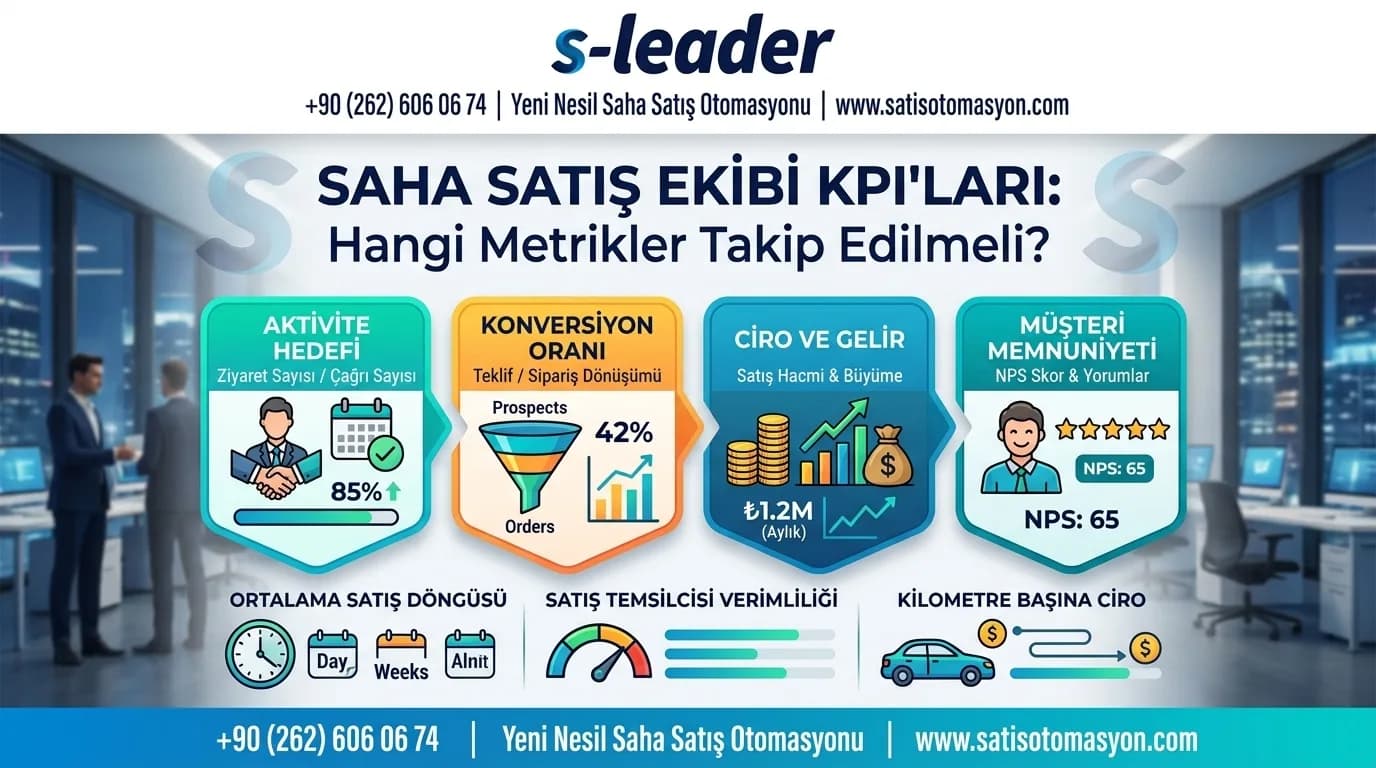
Many field sales managers measure performance with a single number: revenue. Revenue matters, of course, but looked at on its own it doesn't tell you why it dropped or where the opportunity for improvement actually is. The right set of KPIs lets you see the problem at its source — a specific region, rep, product group, or process step. This article covers the core KPIs that let you measure your field sales team's performance in a way that's actually useful.
Quick summary: the core KPIs to track
- Revenue and target achievement — broken down by region, rep and product
- Coverage (visit completion rate) — what share of planned visits actually happened
- Collection performance — target vs. actual collections and overdue receivables
- PSKU (product availability) — how often a product that should be on the shelf or in stock actually is
- Route adherence — the gap between the planned route and what actually happened in the field
- Rep-level efficiency — average order value per visit and order conversion rate
Revenue and Sales KPIs
Revenue tracking shouldn't stop at a single total. A meaningful analysis needs revenue broken down by region, rep, customer segment and product group. If total revenue falls short of target, this breakdown lets you quickly tell whether the issue is confined to one region or reflects a broader trend. Comparing target-vs-actual over time (this month vs. last month, this year vs. last year) also helps you separate seasonality from a genuine performance drop.
Coverage (Visit Completion Rate)
Coverage is the share of planned visits that actually took place. A low coverage rate is an early warning sign that the field team isn't fully executing the route — or that the plan itself isn't realistic. In many cases, the real reason revenue misses target isn't a lack of selling skill, but that a chunk of the planned visits simply never happened. That makes coverage a leading indicator you should check before you even look at the revenue number.
Collection and Receivables KPIs
In any sector with credit sales, collection performance needs as much attention as sales. Track actual collections against target, total overdue receivables, and checks/notes coming due. Giving reps access to this data in the field lets them remind a customer about an overdue payment and plan accordingly during the visit; on the management side, it surfaces cash-flow risk early.
Product Availability (PSKU)
PSKU — the rate at which a product that should be on the shelf or in stock is actually there — is a critical metric for spotting lost sales, especially in distribution and retail. If a product consistently shows a low PSKU rate in a given region, that can point to a supply chain gap, poor stock planning, or a competitor's product taking the shelf space. Without tracking this at the product/category level, this kind of loss is nearly impossible to spot by looking at total revenue alone.
Route Adherence and Time Efficiency
Route adherence measures the gap between the planned visit sequence and timing and what actually happens in the field. A rep who consistently deviates from the planned route is a sign either that the route plan isn't realistic or that there's a field discipline issue. Logging visit start/end times and location data lets you measure this objectively and refine the route plan based on real data.
Rep-Level Performance Metrics
Team-wide totals matter, but so does the rep-level breakdown. Metrics like average order value per visit, order conversion rate (how many of the customers visited resulted in an order), and commission accrual let you evaluate performance fairly — and clearly identify the actual cause of underperformance: too few visits, low conversion, or low average order size.
How to Actually Track These KPIs
For these KPIs to be useful, they need to be visible as close to real time as possible — not just at month-end. The S-Leader BackOffice panel shows revenue, coverage, collection and PSKU targets against actuals, both graphically and numerically, in real time. Companies that need more can design custom metrics with the report builder rather than relying on fixed screens.
The Cost of Missing or Wrong KPIs
A manager who only tracks total revenue finds out about a problem at month-end — often too late to fix it well. Without leading indicators like coverage, collections, and PSKU, the real reason behind a revenue drop (missed visits, an empty shelf, overdue collections) stays unclear, and management ends up acting on a general assumption instead of the actual cause.
If you'd like to review which KPIs you're tracking, and how often, and see the S-Leader BackOffice panel with your own data, you can request a free demo. For guidance on choosing a system that tracks these KPIs correctly in the first place, see our 10 criteria for choosing field sales automation.
Sıkça Sorulan Sorular
What's the single most important KPI for a field sales team?
Reducing it to one KPI is misleading — revenue, coverage (visit completion rate), collection performance and PSKU need to be tracked together. Coverage in particular is a leading indicator: a low revenue number is usually explained first by low coverage.
What is coverage, and how is it calculated?
Coverage is the share of planned visits that actually happened (visits completed ÷ visits planned). Low coverage is usually the real reason revenue targets are missed.
What is PSKU?
PSKU is the rate at which a product that should be present (on the shelf, in the warehouse) actually is. Low PSKU is a critical metric that points to lost sales opportunities and possible supply chain issues.
Why does it matter to track KPIs before month-end?
A static report produced at month-end usually means you've already missed the window to fix the problem. Real-time dashboards, like S-Leader BackOffice, let you spot and act on an issue within the same week.
How can I compare rep performance fairly?
Looking only at total revenue can be misleading. Combining average order value per visit, order conversion rate, and coverage gives a fairer, cause-based comparison.
Can S-Leader show all of these KPIs in one panel?
Yes. The S-Leader BackOffice panel shows revenue, coverage, collection and PSKU targets against actuals; the report builder also lets you create additional metrics specific to your company.