
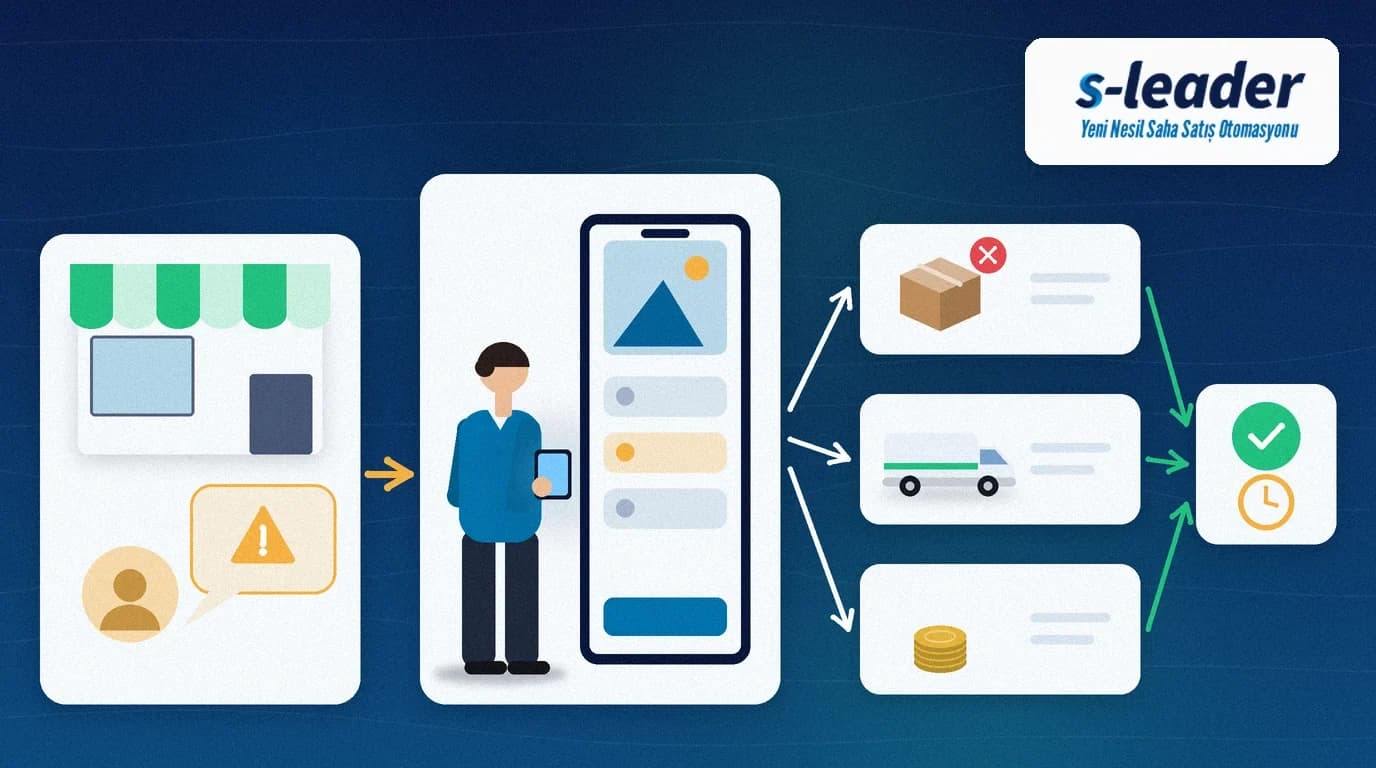
In short: Customer complaint handling is the process of listening to a complaint, recording it completely, passing it to the team responsible, getting back to the customer and closing it once the fix is confirmed. In the field, the rep's job is not to solve every complaint personally but to record it with the right details, pass it on the same day and tell the customer when they will hear back.
A rep walks into a shop, and before any order is taken the owner says: "Two of last week's boxes arrived crushed, and one item was invoiced at the wrong price." Handled badly, a complaint like this means a smaller next order or a switch to another supplier. This article explains step by step how field teams should log a complaint and follow it until it is resolved.
What is customer complaint handling in field sales?
Customer complaint handling in field sales means that complaints raised during a visit or by phone are recorded in a shared log, not in someone's memory or notebook, and resolved through that record. The goal is to know at any time who owns each complaint, when it will be solved and how it was closed.
Complaints often come from things outside the rep's control: damaged goods, short or late deliveries, invoice errors, a promotion that was not applied. The customer, however, only sees the rep. That makes the rep the company's first point of contact for every complaint.
What should a complaint record contain?
An incomplete record makes a complaint bounce between departments. During the visit the rep should capture:
- Customer and date: account name, date received and who raised it.
- Subject and type: a category such as product quality, delivery, price or invoice, promotion or service.
- Related document: order, delivery note or invoice number.
- Product and quantity: if a product is involved, the item, batch details and the quantity affected.
- Evidence: a photo of the damaged product or packaging.
- What the customer wants: replacement, return, price correction or just information.
- The promise made: who will get back to the customer, and by when.
We cover what belongs in a visit record in general in our field visit report article; a complaint record can be seen as a special part of it.
Customer complaint handling in 6 steps for field reps
1. Listen without getting defensive
Let the customer finish and briefly repeat what you understood. A summary such as "Two boxes arrived crushed and one item has the wrong price, correct?" shows that you take it seriously. Do not look for someone to blame and do not promise a solution at this stage.
2. Collect evidence on the spot
Take photos of the damaged product, label or packaging and note the related document number. If you try to collect evidence later, the goods have often been sold, thrown away or spread across the shelf.
3. Classify the complaint by type
Give each complaint a type. The type decides where it goes: quality issues to quality or purchasing, delivery issues to logistics, price and invoice errors to accounting or sales management. If damaged or expired goods are returned, combine the process with the steps in our field sales returns management article.
4. Pass it on the same day
Send the complaint with the details and photos to the person responsible on the same day. Use a written, traceable channel rather than a verbal handover; our field team communication article shows how to organise messaging in the field team.
5. Give the customer a clear reply date
Even if you do not decide the solution, tell the customer who you passed it to and when they will hear back. That date should be a realistic one agreed with the departments beforehand. If there is no solution yet on that date, call the customer anyway and update them.
6. Confirm the fix and close the record
Once the fix is in place, for example the product is replaced or the invoice corrected, ask the customer at the next visit to confirm the problem is really solved, then close the record. Report complaints that are still open at the end of the day; see our end-of-day report guide for a routine.
Common mistakes
Brushing the complaint off without recording it: saying "I'll tell head office" without a note brings the same complaint back more angrily at the next visit.
Making promises without authority: a rep promising a discount, free goods or a return on their own creates a new complaint.
Not collecting evidence: without photos and document numbers, departments cannot verify the complaint and the process drags on.
Not closing the record: complaints that are solved but left open make it hard to see which problems recur.
Only handling complaints one by one: complaints that repeat for the same product, warehouse or region point to a root cause. Review the records together on a regular basis.
How S-Leader supports the field team
The S-Leader field sales app has no separate complaint module, but key steps of the complaint process are supported by its existing features. Reps see the customer's account balance, past orders and sales in the field instantly, which makes it easier to find the order or invoice a complaint relates to. Returns of damaged or wrong products are recorded in the field with product, quantity and reason and posted to the account after BackOffice approval. Team members can communicate in writing or by video, and conversations can be followed in BackOffice; push notifications deliver urgent announcements even when the app is closed. Custom reports can be built with the report designer.
Summary
Customer complaint handling in the field needs routine more than goodwill: listen, collect evidence on the spot, classify the complaint, pass it on the same day, give the customer a clear reply date and close the record once the fix is confirmed. Contact us to see how S-Leader gives your field team access to customer information and communication tools.
Sıkça Sorulan Sorular
Can a field rep resolve a customer complaint alone?
A rep can settle simple issues within their authority in the field, but decisions such as returns, price corrections or free goods need approval from the responsible team. The rep's main job is to record the complaint completely and pass it to the right person the same day.
How quickly should the customer get a reply?
That depends on the type of complaint and your internal processes. What matters is giving a realistic reply date agreed with the departments in advance and updating the customer on that date even if the fix is delayed.
What is the difference between a complaint and a return?
A complaint is the customer reporting a problem; a return is taking goods back. A return can come from a complaint, but not every complaint ends in a return. An invoice error, for example, can be corrected without any return.
Why should complaint records be reviewed regularly?
Complaints that look minor one by one can, taken together, reveal a recurring problem with the same product, warehouse or region. Reviewing them helps find the root cause and prevent the same complaint from coming back.