
Distributor and Dealer Management Software: Features and Selection Criteria
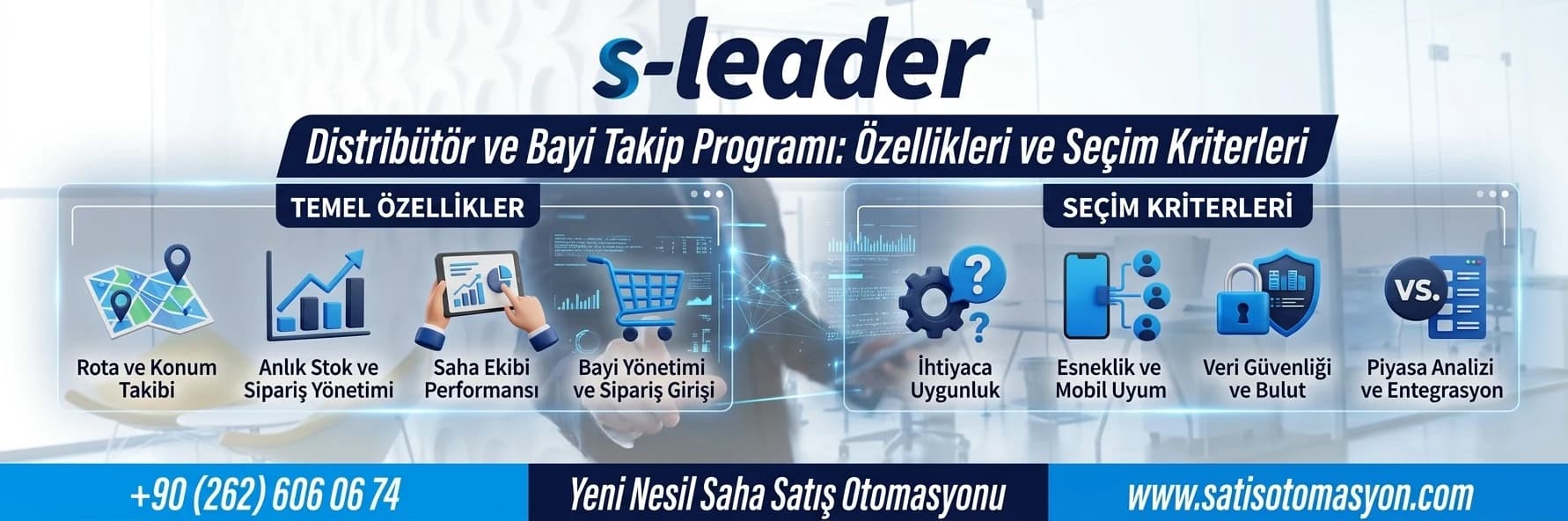
For companies that sell through a distributor or dealer network, tracking which dealer ordered how much, how far each region is behind its revenue target, and how much each dealer still owes becomes increasingly unmanageable with spreadsheets and phone calls as the network grows. In this article we cover what distributor and dealer management software is, which core features it should include, and what to look for when choosing the right system.
Quick summary
- Distributor/dealer management software brings order, collection, visit and performance data together in one system, broken down by dealer.
- Tracking with spreadsheets and phone calls leads to data delays, errors and lost visibility as the network grows.
- Core features a good system should have: dealer-level order/account tracking, collections and receivables management, field visit logging, ERP integration and dealer-level reporting.
- When choosing, pay particular attention to ERP integration, offline capability and dealer-level access control.
What Is Distributor and Dealer Management Software?
Distributor and dealer management software is a system that lets a company digitally manage its order, collection, visit and performance relationship with its own dealer/distributor network. Unlike a classic CRM, the focus here isn't a relationship with individual end customers, but a network of dealers/distributors who order regularly, have a running account, and usually buy on credit terms. A field sales automation system like S-Leader is designed to meet exactly this need.
Why Do You Need It?
While the dealer network is small, a few spreadsheets and phone calls may seem enough. But as the number of dealers grows, certain problems become unavoidable: it's unclear when each dealer last ordered, spreadsheets held by different people drift out of sync, dealers with overdue payments aren't noticed in time, and comparing performance by region turns into hours of manual work. The result is both lost sales and cash-flow risk.
Core Features It Should Have
- Dealer-level order and account tracking: Each dealer's current order history, account balance and stock/price information should be visible on a single screen.
- Collections and receivables management: Overdue collections, check/note due dates and collection target vs. actual should be trackable per dealer.
- Field visit logging: The frequency and outcome of dealer visits (was an order taken, was a payment collected) should be recorded.
- ERP integration: Orders and collections from dealers should flow directly into the ERP (Logo/Mikro) without being re-entered by hand.
- Dealer-level reporting: It should be possible to see how far each dealer is above or below target, compared by region and period.
- Access control: Field teams and managers responsible for different regions/dealer groups should only see their own area of responsibility.
Challenges That Arise as the Distributor Network Grows
As the number of dealers grows, it becomes practically impossible for one person or a handful of spreadsheets to track the whole network. Whether the current tracking method will scale when a new region or dealer is added is the most commonly overlooked issue. In a digital system, adding a new dealer takes a few minutes; in a setup built on scattered spreadsheets, it means a new file structure and extra coordination — and usually leads to inconsistent data.
What to Look for When Choosing a System
Three criteria matter most when evaluating dealer/distributor management software. The first is ERP integration: having dealer orders and collections transferred to accounting automatically rather than by hand both reduces errors and speeds up month-end reconciliation. The second is offline support: field teams don't always have a strong connection, so the system needs to allow order/collection entry without one. The third is dealer/region-level access control: in a growing network, each user seeing only their own area is necessary for both data security and reporting clarity.
How S-Leader Helps with Distributor/Dealer Management
S-Leader lets the field team take orders and collect payments on every dealer visit, has these transactions posted automatically to Logo or Mikro ERP, and lets management track dealer/region performance in real time from the BackOffice panel. Thanks to offline support, dealers in areas with weak connectivity aren't left out of the process, and the route planning module lets you systematically track how often each dealer is visited.
If you'd like to see how S-Leader can transform the way you manage your dealer/distributor network, you can request a free demo. For a broader list of criteria to consider when choosing field sales automation, see our article on the 10 criteria.
Sıkça Sorulan Sorular
Is distributor management software the same as a CRM?
No. A CRM usually manages relationships with individual prospects and sales opportunities; distributor/dealer management software manages the order, collection and visit process of a dealer network that orders regularly and has a running account.
Do we need such a system if we only have a few dealers?
With few dealers, spreadsheets may seem enough, but manual tracking quickly becomes unmanageable as the network grows. Moving to a digital system early prevents data loss and confusion during growth.
How are orders from dealers transferred to the ERP?
In integrated systems like S-Leader, an order taken from a dealer and approved is automatically posted to Logo or Mikro ERP; there's no need to re-enter the data by hand.
How is dealer-level collection tracking done?
The system shows the field team and management each dealer's account balance, overdue amount and check/note due dates in real time, so late payments can be spotted early and planned for.
Can teams responsible for different regions work in the same system?
Yes. With user-level access control, each team or manager can be set up to see only the dealer/region data they're responsible for.
Will the system struggle as our distributor network grows?
No — quite the opposite. Adding a new dealer or region to a digital system is quick, and the reporting and access-control structure stays consistent regardless of network size.