
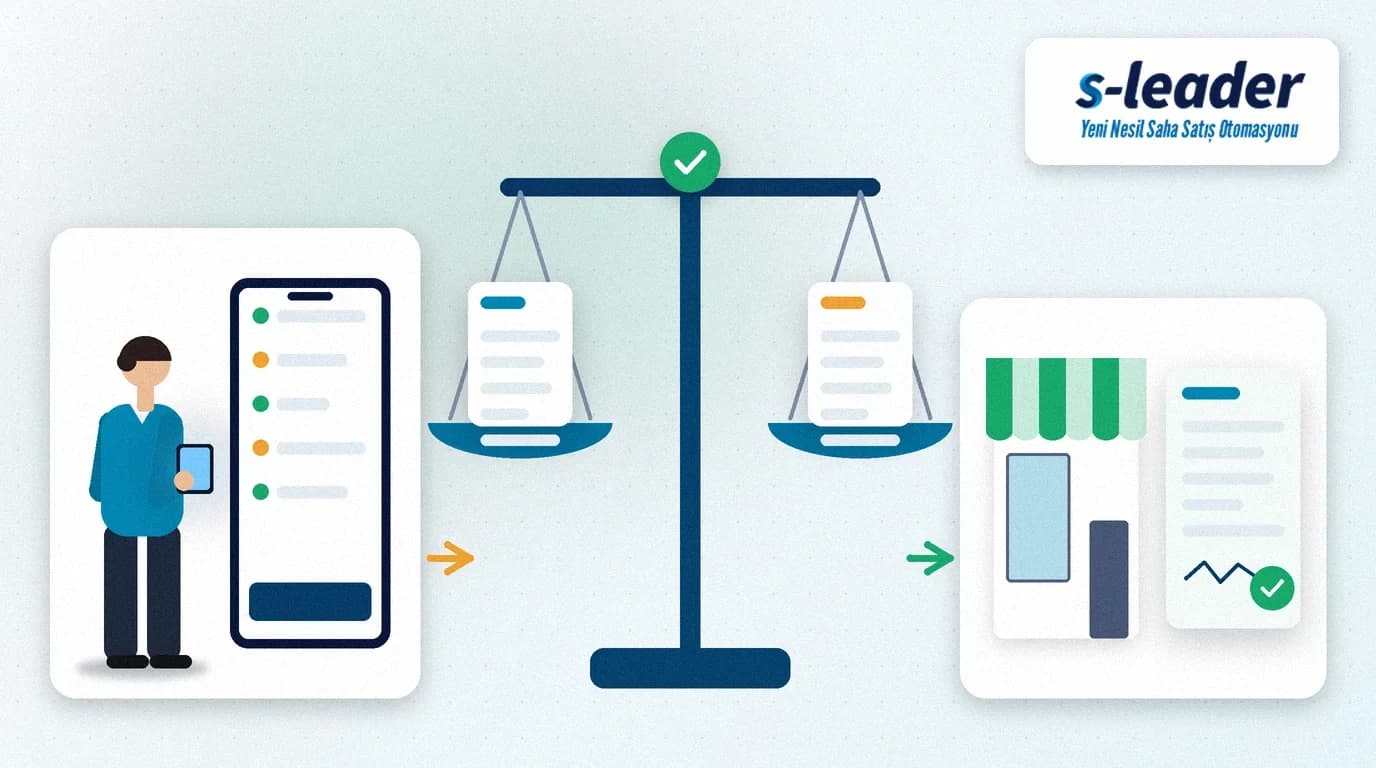
In short: Customer account reconciliation means comparing the records that the seller and the customer keep for the same account and confirming that the balance is the same on both sides. When a difference comes up during a visit, the rep's job is not to argue about it but to start from the last agreed balance, compare the movements line by line, find the source of the difference and pass the fix, on record, to the team responsible.
A rep arrives to collect a payment and the customer looks at the statement and says: "This figure is wrong, our books show less." That moment puts both the payment and the relationship at risk: until the difference is resolved, the customer delays payment and holds back on the next order. This article explains why balance differences arise and how a field rep can close them with a clear routine.
What is customer account reconciliation?
Customer account reconciliation is the comparison, as of a given date, between the customer balance in the seller's accounts and the supplier balance in the customer's own records, confirmed by both sides as matching. Accounting usually runs reconciliations periodically; for field teams, what matters is handling the moment when a balance question comes up during a visit.
The last agreed balance is the starting point for every later check. Without that date and amount, a comparison easily gets lost in months of transactions.
Why do balances differ?
Most differences are not caused by an error on one side but by entries being recorded at different times or in different ways:
- Payments in transit: a bank transfer or a collection handed over has not yet been posted in the seller's books.
- Cheques and notes not yet due: a cheque may look settled on one side and open on the other.
- Unprocessed returns: a return taken in the field has not yet been approved and posted to the account.
- Price and discount differences: the invoiced price or promotion discount differs from what the customer expected.
- Invoices the customer has not booked: an issued invoice has not yet reached the customer's records.
- Entries on the wrong account: a payment or invoice posted to a customer with a similar name or in the same group.
Many of these causes start in the field. That is why recording collections and returns completely during the visit is the first step of reconciliation. We cover the collection side in field sales collection tracking.
Customer account reconciliation in 6 steps for field reps
1. Prepare the statement before the visit
Before going to the customer, review the movements since the last agreed balance: open invoices, cheques and notes received, and pending returns. For everything else worth checking before a call, see pre-visit preparation.
2. Agree on the starting point
First agree with the customer on the date and amount of the last agreed balance. If you cannot agree even on that, the difference goes further back and the matter should go straight to accounting.
3. Compare movements line by line
Put the customer's list or statement next to yours. Tick the lines where amount and date match; the remaining lines are the candidates for the difference. Rather than explaining the total gap with one item, deal with each unmatched line separately.
4. Classify the cause
Write a cause next to every unmatched line: payment in transit, cheque not yet due, unprocessed return, price difference, missing invoice or wrong account. Mark lines with no clear cause as "unexplained"; accounting should look at these first.
5. Do not fix it yourself, pass it on
Field reps do not correct account entries. Send price differences to the sales manager, returns to the team that approves them and posting errors to accounting, the same day and with the relevant document, photo or note. Tell the customer who it went to and when they will hear back.
6. Confirm the result and record it
Once the difference is closed, confirm the new balance with the customer in writing and record that date as the new starting point. Set a follow-up date for anything still open and report open items at the end of the day; our end-of-day report guide shows how.
Common mistakes
Arguing over the total: without comparing lines, both sides feel right and nothing is settled.
Bargaining the difference against the payment: "let's drop the difference and you pay the rest" only makes the records messier.
Not recording the cause: only recorded causes show whether the same type of difference keeps recurring with other customers.
Settling for a verbal confirmation: without written confirmation, the same discussion starts again at the next visit.
Tracking customer accounts in the field with S-Leader
With the S-Leader field sales app, reps see the customer's account balance, past orders and sales in the field instantly; account debit movements and overdue and upcoming collections are shown in the app as well. Cheque and note due dates and amounts are calculated, and returns taken in the field are recorded with product, quantity and reason and posted to the account after BackOffice approval. Because approved orders and collections are transferred automatically to Logo or Mikro ERP, the time gap between field and head office records shrinks. Team messaging and notifications help follow up on differences passed to accounting.
Summary
In the field, account reconciliation is a checklist, not an argument: agree on the last confirmed balance, compare movements line by line, note the cause of every difference, pass the fix to the person responsible and get the result confirmed in writing. Contact us to see how S-Leader gives your field team access to account information.
Sıkça Sorulan Sorular
How often should accounts be reconciled?
That depends on your accounting policy; many companies reconcile periodically. In the field, the same process should be applied on a small scale as soon as a balance question comes up.
Can a field rep correct the balance difference?
No. The rep finds the difference, notes the cause and passes it with the documents to the team responsible. Corrections to account entries should be made by accounting or another authorised team.
What if the customer does not accept the difference?
Send the unmatched lines and related documents to accounting and give the customer a date for an answer. Keeping disputed items separate until they are resolved makes it easier to agree on the rest of the balance.
Should the reconciliation be confirmed in writing?
Yes, written confirmation is recommended. A signed form or an email sets a clear starting point for the next check and prevents the same discussion from repeating.