
What Is the Difference Between a Field Sales App and a CRM?
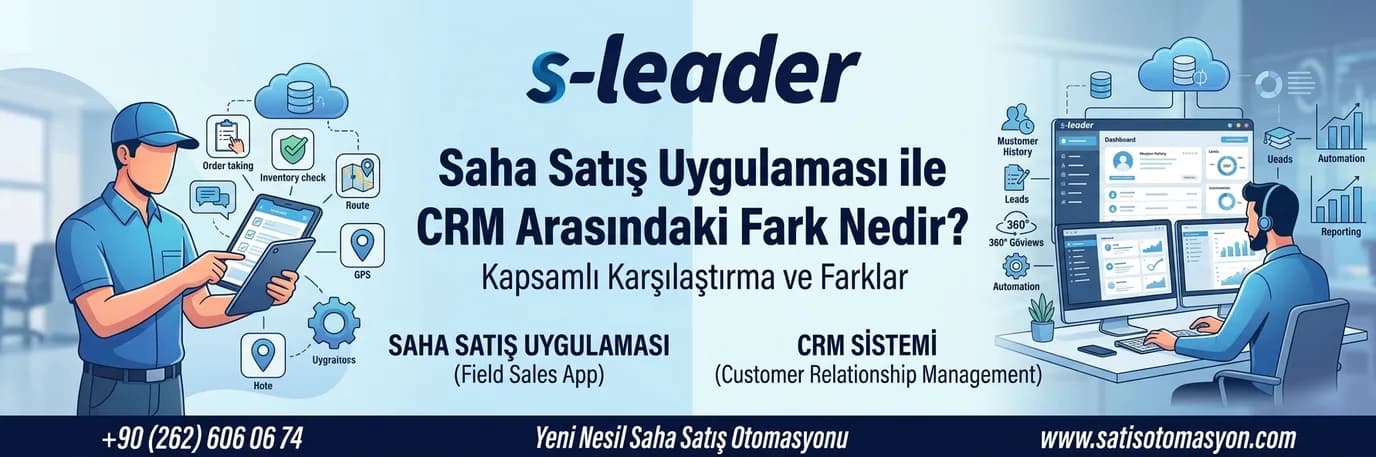
Plenty of companies start their software search with the question "should we get a CRM or a field sales app?" Because both are marketed under the umbrella of "sales software," they're often assumed to be interchangeable. In reality they solve different problems, and choosing the wrong one wastes both budget and time. In this article we clarify the key differences between a CRM and a field sales app (field sales automation), and which type of company needs which.
Quick summary: CRM or field sales app?
- A CRM manages customer relationships and sales opportunities (leads, quotes, the sales funnel) — typically designed for an office/desk-based sales team.
- A field sales app manages the orders, collections, routes and stock handled by a team that makes physical visits — offline capability and ERP integration are critical features in this category.
- Distributors, dealer networks, or any company that takes orders through field visits usually need a field sales app; a CRM doesn't cover the operational needs of field sales.
- Some companies need both: a CRM for managing leads and prospects, and a field sales app for the order/collection operations run with existing customers.
What Is a CRM and What Does It Manage?
CRM (Customer Relationship Management) is a system that lets a company track its communication with prospects, sales opportunities, and where each deal sits in the sales funnel. A typical CRM focuses on lead records, opportunity/quote tracking, email and call history, and sales funnel reporting. Its typical user is a sales rep — in the office or visiting customers — who does not process orders or deliveries directly (e.g. corporate/B2B sales, consulting sales).
What Is a Field Sales App (Field Sales Automation)?
A field sales app manages the operational process of a field team that makes regular physical visits and takes orders and collects payments during those visits. In a system like S-Leader, the focus is on order entry and approval, viewing customer balances and stock, collection and check/note tracking, route planning, and automatically pushing approved transactions to the ERP (Logo/Mikro). Unlike a CRM, a field sales app answers "how do we handle the order, payment, and route during this visit" rather than "when should we next talk to this customer."
Key Differences
- Focus: CRM manages customer relationships and sales opportunities; a field sales app manages order, collection and route operations.
- Typical user: CRM users are office/corporate sales reps; field sales app users are reps who make regular visits and process orders/collections on the spot.
- Offline capability: most CRMs assume constant internet access; field sales apps need to keep working in areas with weak connectivity.
- ERP integration: an optional add-on for CRM; for a field sales app, getting orders and collections correctly into accounting is a core purpose.
- On-site documents/invoices: CRMs typically don't offer this; systems like S-Leader support barcode scanning and wireless invoice printing via Bluetooth printers in the field.
- Reporting focus: CRM reports on the sales funnel and conversion rates; a field sales app reports on revenue, visit coverage, product availability (PSKU) and collection targets.
Which Companies Need Which?
If your field team regularly visits the same network of customers (dealers, retail points, distribution points) to take orders and collect payments, what you need is a field sales app — for these companies the lead management/sales funnel features of a CRM largely go unused. Conversely, if your sales process involves long conversations, proposal preparation, and multi-stage decision makers (e.g. software, consulting, or corporate services sales), a CRM is the better fit — for these companies most of a field sales app's order/collection/route features would go unused.
Can You Use Both Together?
Yes — for some companies the two complement each other. For example, relationships with new dealer/distributor prospects can be managed through a CRM, while the recurring order/collection operation with active, approved customers runs through a field sales app. In this scenario the two systems cover different stages of the process; trying to force one to do the other's job (e.g. squeezing order processing into a CRM) usually results in a half-built solution nobody uses in the field.
The Cost of Choosing the Wrong System
If a company with field operations buys only a CRM, the field team keeps using a separate method (paper, spreadsheets, phone calls) for orders and collections, data gets entered into the ERP by hand, and the CRM's customer records stay disconnected from what's actually happening operationally. The reverse is also true: if a company that only does corporate sales buys a field sales app, the order/collection/route modules go unused, and the sales team keeps managing the lead/funnel tracking it actually needs in a separate, usually scattered spreadsheet. In both cases, the investment doesn't deliver the expected value because it doesn't match the real process.
If you'd like help identifying the right tool for your field operation, you can request a free demo and see together whether S-Leader fits your needs. For a deeper look at selection criteria, see our guide on 10 criteria to consider when choosing field sales automation.
Sıkça Sorulan Sorular
Do a field sales app and a CRM do the same job?
No. A CRM manages customer relationships and sales opportunities (leads, quotes, the sales funnel); a field sales app manages the orders, collections, routes and stock handled in the field. The two focus on different processes.
Is a CRM enough for a small field sales team?
Usually not. CRMs typically lack field-specific features such as order entry, collection tracking, offline capability, or automatic ERP sync. If your field team takes orders and collects payments, a field sales app is the better fit.
Is S-Leader a CRM?
No, S-Leader is a field sales automation system. While it gives field reps access to customer history and balances, its core focus is order processing, collections, routing and ERP integration — not the lead/sales-funnel management a classic CRM provides.
Can a CRM and a field sales app be used together?
Yes. Relationships with new prospects can be managed through a CRM, while the recurring order/collection operation with active customers runs through a field sales app; the two systems can complement each other.
Can field sales features be added to a CRM later?
Some CRMs offer partial field support through add-ons or modules, but features like offline operation, real-time ERP integration, and on-site invoicing/barcode support are usually stronger in systems purpose-built for field sales automation.
How do I decide which system to choose?
The key question is: does your field team take orders and collect payments, or manage long-running opportunities and proposals? If the former, a field sales app is the better starting point; if the latter, a CRM is.